TL;DR: ISO27001 and SOC2 Type II certifications are increasingly critical for software companies, but the SDLC-specific requirements—access control audits, change management traceability, vulnerability response times, and continuous monitoring—create massive documentation burdens. Traditional approaches require 6-12 months of manual evidence collection, costing $150K-$400K annually. Keypup MCP Server automates compliance monitoring by continuously analyzing your SDLC data, generating audit-ready reports, tracking security controls, and providing real-time compliance dashboards—reducing initial certification time by 40-60% and ongoing maintenance costs by 50-70%.
- Key Point 1: ISO27001 (A.8.31, A.8.32) and SOC2 CC6.6/CC6.8 require detailed SDLC controls including code review audits, access management logs, change authorization trails, and vulnerability remediation tracking—all of which live in your GitHub/Jira/Azure DevOps data but are difficult to extract and format for auditors.
- Key Point 2: Continuous compliance monitoring through Keypup MCP transforms certification from a painful annual audit sprint into an always-ready state, with automated evidence collection running 24/7, real-time policy violation detection, and instant audit report generation that reduces auditor engagement time from weeks to days.
- Key Point 3: The ROI of automated SDLC compliance is substantial: organizations using Keypup MCP for ISO27001/SOC2 save an average of $120K in first-year certification costs and $80K annually in maintenance, while achieving certification 4-6 months faster and reducing compliance team overhead by 60-75%.
Introduction: When Security Certifications Meet Software Development Reality
Your sales team just lost a $2M enterprise deal. The reason? "We need to see your ISO27001 certification before we can proceed." Your CFO is pushing for SOC2 Type II to unlock Series B funding. Your head of security is drowning in spreadsheets trying to document your software development lifecycle for auditors.
Welcome to the modern software company dilemma: security certifications are no longer optional nice-to-haves—they're mandatory tickets to market. But achieving and maintaining ISO27001 and SOC2 Type II compliance creates a special challenge for engineering organizations because these frameworks impose extensive requirements on how you develop, deploy, and manage software.
The problem isn't that your engineering practices are inadequate. Most well-run development teams already implement the security controls these frameworks require: code reviews, access management, change control, vulnerability patching, deployment tracking. The problem is proving it to auditors in the specific format they demand.
We spent 8 months preparing for our SOC2 Type II audit. Our engineering practices were solid—mandatory code review, role-based GitHub access, automated security scanning—but we had to manually reconstruct 12 months of evidence. Every week, our compliance consultant asked for things like 'proof that all PRs affecting production were reviewed by authorized personnel' or 'demonstrate your mean time to remediate critical vulnerabilities.' We'd spend hours writing scripts to extract data from GitHub and Jira, format it into spreadsheets, then explain why our metrics showed we met the controls. It was exhausting and expensive.
This article provides a comprehensive guide to achieving ISO27001 and SOC2 Type II certification for software development organizations, with specific focus on:
- What these certifications actually require from your SDLC
- The specific controls and evidence auditors expect from engineering teams
- How traditional manual approaches waste time and create ongoing compliance debt
- How Keypup MCP Server automates continuous compliance monitoring, evidence collection, and audit reporting
- Concrete examples and ROI calculations showing time and cost savings
Whether you're preparing for your first certification audit or struggling with annual recertification overhead, this guide will show you how to transform compliance from a painful burden into an automated, always-ready capability.
Understanding ISO27001 and SOC2 Type II: What They Are and Why They Matter
Before diving into implementation, let's clarify what these certifications are, how they differ, and why both are increasingly essential for software companies.
ISO27001: The International Security Management Standard
ISO/IEC 27001 is an international standard for information security management systems (ISMS). Published by the International Organization for Standardization (ISO) and the International Electrotechnical Commission (IEC), it provides a systematic approach to managing sensitive company information.
Key characteristics:
- Certification-based: Third-party auditors certify your ISMS against the standard
- Risk-focused: Requires identifying risks and implementing appropriate controls
- Comprehensive: Covers 93 controls across 14 categories (Annex A)
- Global recognition: Accepted worldwide, especially strong in Europe and APAC
- Annual surveillance audits: Recertification every 3 years with annual checks
Why it matters for software companies:
- Enterprise procurement requirement: Many large enterprises (especially European) require ISO27001 from vendors
- Regulatory compliance: Helps satisfy GDPR, NIS2, and other security regulations
- Risk management framework: Provides structured approach to security
- Competitive advantage: Demonstrates commitment to security best practices
SOC2 Type II: The Trust Services Criteria Standard
SOC 2 (Service Organization Control 2) is a US-based auditing standard developed by the American Institute of CPAs (AICPA) that evaluates how service organizations handle customer data. Type II specifically examines operational effectiveness over time (typically 6-12 months).
Key characteristics:
- Report-based: Produces a confidential audit report (not a certificate)
- Trust Services Criteria: Evaluates Security (mandatory), plus optional Availability, Processing Integrity, Confidentiality, Privacy
- US-focused: Required by US enterprises, increasingly global
- Operational evidence: Type II requires 6-12 months of operational data
- Annual audits: Most companies recertify annually
Why it matters for software companies:
- US market access: Essential for selling to US enterprises and government
- Investor requirement: Many VCs require SOC2 before Series B funding
- Customer trust: Demonstrates operational security maturity
- Due diligence: Satisfies security questionnaires and assessments
ISO27001 vs. SOC2: Complementary, Not Competing
Many companies pursue both certifications because they serve different markets and purposes:
| Aspect | ISO27001 | SOC2 Type II |
| Origin | International (ISO/IEC) | US (AICPA) |
| Primary Markets | Europe, APAC, Global | US, increasingly global |
| Output | Certificate | Confidential report |
| Focus | ISMS framework | Operational controls |
| Audit Scope | Point-in-time + surveillance | 6-12 months operational |
| Public Disclosure | Certificate number public | Report shared under NDA |
| Industry Preference | General business | Tech/SaaS |
The overlap: Both require similar SDLC controls (access management, change control, security testing, incident response), which means implementing controls for one largely satisfies the other.
The differences: ISO27001 emphasizes documented procedures and risk assessments; SOC2 emphasizes operational evidence proving those procedures actually work over time.
The SDLC Requirements: What Auditors Actually Want to See
Both ISO27001 and SOC2 Type II impose specific requirements on software development lifecycle activities. Let's break down the key controls that engineering teams must demonstrate.
ISO27001 Annex A Controls for Software Development
The most relevant ISO27001 controls for software development organizations include:
A.8.31 - Separation of Development, Test and Production Environments
- Requirement: Development, testing, and production environments must be separated and protected
- What auditors want: Evidence that developers cannot deploy directly to production, production data is protected, and access is role-based
A.8.32 - Change Management
- Requirement: Changes to information processing facilities and systems shall be subject to change management procedures
- What auditors want: Documented change approval process, traceability from requirements to deployment, rollback procedures
A.5.15 - Access Control
- Requirement: Access to information and systems shall be controlled on a business need-to-know basis
- What auditors want: Evidence of least-privilege access, regular access reviews, access removal when roles change
A.5.16 - Identity Management
- Requirement: The full lifecycle of identities shall be managed
- What auditors want: User provisioning/deprovisioning logs, authentication controls, MFA implementation
A.8.8 - Management of Technical Vulnerabilities
- Requirement: Information about technical vulnerabilities shall be obtained and managed
- What auditors want: Vulnerability scanning process, remediation tracking, mean time to patch critical vulnerabilities
SOC2 Trust Services Criteria for Software Development
The most relevant SOC2 criteria for engineering teams include:
CC6.1 - Logical and Physical Access Controls
- Requirement: The entity implements logical access security software, infrastructure, and architectures
- What auditors want: Evidence of authentication mechanisms, role-based access, and access logging
CC6.6 - Logical Access Control - Restrict Access
- Requirement: Prior to issuing system credentials, the entity registers and authorizes new users
- What auditors want: User provisioning workflow, access approval records, periodic access reviews
CC6.8 - Logical Access Control - Prevent and Detect Unauthorized Access
- Requirement: The entity restricts access to system configurations and settings
- What auditors want: Evidence that production access is logged, monitored, and reviewed
CC7.2 - System Monitoring - Detect and Respond
- Requirement: The entity monitors system components and the operation of those components for anomalies
- What auditors want: Security monitoring logs, incident detection mechanisms, response procedures
CC8.1 - Change Management - Document Changes
- Requirement: The entity authorizes, designs, develops or acquires, configures, documents, tests, approves changes
- What auditors want: Change request records, approval workflows, testing evidence, deployment logs
The Evidence Burden: What You Must Produce for Auditors
For both certifications, auditors will request evidence demonstrating that your controls operate effectively. Common requests include:
Access control audit trail: "Show me all individuals who had production access during the audit period, when access was granted, who approved it, and when it was revoked when they changed roles."
Code review evidence: "Demonstrate that 100% of production code changes were reviewed by authorized personnel before deployment."
Change management traceability: "For these 10 randomly selected production deployments, show me the associated Jira ticket, code review, approval, and deployment log."
Vulnerability remediation tracking: "Show me all critical vulnerabilities detected in the last 12 months, their severity scores, when they were detected, and your mean time to remediation."
Incident response records: "Provide all security incidents in the last year, including detection time, response actions, resolution time, and root cause analysis."
Separation of duties: "Prove that developers cannot approve their own code or deploy without review."
Access reviews: "Show quarterly access review reports demonstrating that production access was validated and inappropriate access was revoked."
The challenge: all this data exists in your GitHub, Jira, PagerDuty, and security tools—but extracting it, formatting it consistently, and presenting it in audit-ready form requires enormous manual effort.
The Traditional Approach: Manual Evidence Collection and Its Costs
Before we explore automated solutions, let's understand the traditional manual approach and why it's so expensive and time-consuming.
The Manual Certification Process
A typical ISO27001 or SOC2 Type II certification journey looks like this:
Phase 1: Gap Analysis (2-3 months)
- Hire compliance consultant ($15K-$40K)
- Map existing SDLC practices to framework requirements
- Identify control gaps and create remediation plan
- Implement missing controls (MFA, logging, access reviews, etc.)
Phase 2: Documentation (3-4 months)
- Write policies and procedures for all required controls
- Document SDLC workflows (code review, deployment, incident response)
- Create evidence collection procedures
- Train engineering team on compliance requirements
Phase 3: Evidence Collection (2-4 months)
- Manually export data from GitHub, Jira, and other tools
- Write scripts to analyze PRs, deployments, access logs
- Format data into spreadsheets auditors can review
- Create narrative explanations for each control
Phase 4: Audit (1-2 months)
- Auditor requests samples and evidence
- Team scrambles to find requested data
- Multiple rounds of clarifications and additional evidence
- Remediate any findings before final report
Total timeline: 8-13 months Total cost: $150K-$400K (consultant fees + internal time + audit fees)
The Ongoing Maintenance Burden
Once certified, the pain doesn't end. Annual recertification requires:
- Continuous evidence collection: Someone must regularly export and archive SDLC data
- Quarterly access reviews: Manually audit who has production access
- Incident documentation: Every security event must be logged and analyzed
- Change control audits: Sample deployments and trace back to approvals
- Surveillance audits: Annual re-audits to maintain certification
Annual maintenance cost: $80K-$150K (ongoing consultant fees + internal overhead + audit fees)
Our first SOC2 audit took 11 months and cost us $280K between consultant fees and internal time. But the ongoing maintenance is worse—we have one engineer spending 20% of their time on 'compliance work,' which is really just exporting GitHub data, building evidence spreadsheets, and responding to auditor requests. That's $60K in engineering salary annually just to maintain compliance. And every time an auditor asks for a new data cut, we write another one-off script.
Why Manual Approaches Fail at Scale
The manual approach creates several problems:
Point-in-time compliance: Evidence is collected for audits, creating a scramble every year rather than continuous readiness
Data fragmentation: Evidence lives across GitHub, Jira, PagerDuty, Slack, requiring integration scripts for each audit
Inconsistent formatting: Each auditor wants data formatted differently, requiring rework
No real-time visibility: Compliance team doesn't know if controls are working until they check manually
High overhead: Significant ongoing effort diverts engineering resources from product development
Human error: Manual data collection and analysis introduces errors that auditors flag
Lack of trend analysis: Difficult to track compliance posture over time or identify degrading controls
The solution: automated, continuous compliance monitoring that treats certification as an operational capability, not a periodic event.
Keypup MCP Server: Continuous SDLC Compliance Automation
Keypup MCP Server transforms ISO27001 and SOC2 Type II compliance from a manual burden into an automated, always-ready capability by continuously monitoring your SDLC data and generating audit-ready evidence on demand.
How Keypup MCP Enables Continuous Compliance
Keypup MCP Server connects to your software development tools (GitHub, GitLab, Bitbucket, Azure DevOps, Jira, Linear, etc.) and continuously analyzes activity against compliance requirements:
Continuous Data Collection
- Real-time ingestion of commits, PRs, code reviews, deployments, access changes
- Automated parsing of security scan results, vulnerability reports, incident tickets
- Historical data retention for complete audit trails (typically 12-24 months)
Policy-Based Monitoring
- Define compliance rules (e.g., "all production PRs must have 2+ approvals")
- Real-time detection of policy violations
- Automated alerts when controls fail
Automated Evidence Generation
- On-demand audit reports covering any time period
- Pre-formatted evidence packages matching auditor requirements
- Natural language queries to answer specific compliance questions
Compliance Dashboards
- Real-time visibility into compliance posture
- Trend analysis showing control effectiveness over time
- Drill-down capability to investigate violations
Demonstrating ISO27001 Controls with Keypup MCP
Let's walk through specific ISO27001 controls and show how Keypup MCP automates evidence collection:
A.8.31: Separation of Environments - Access Audit
Control requirement: Prove that developers cannot deploy directly to production and that access is appropriately segregated.
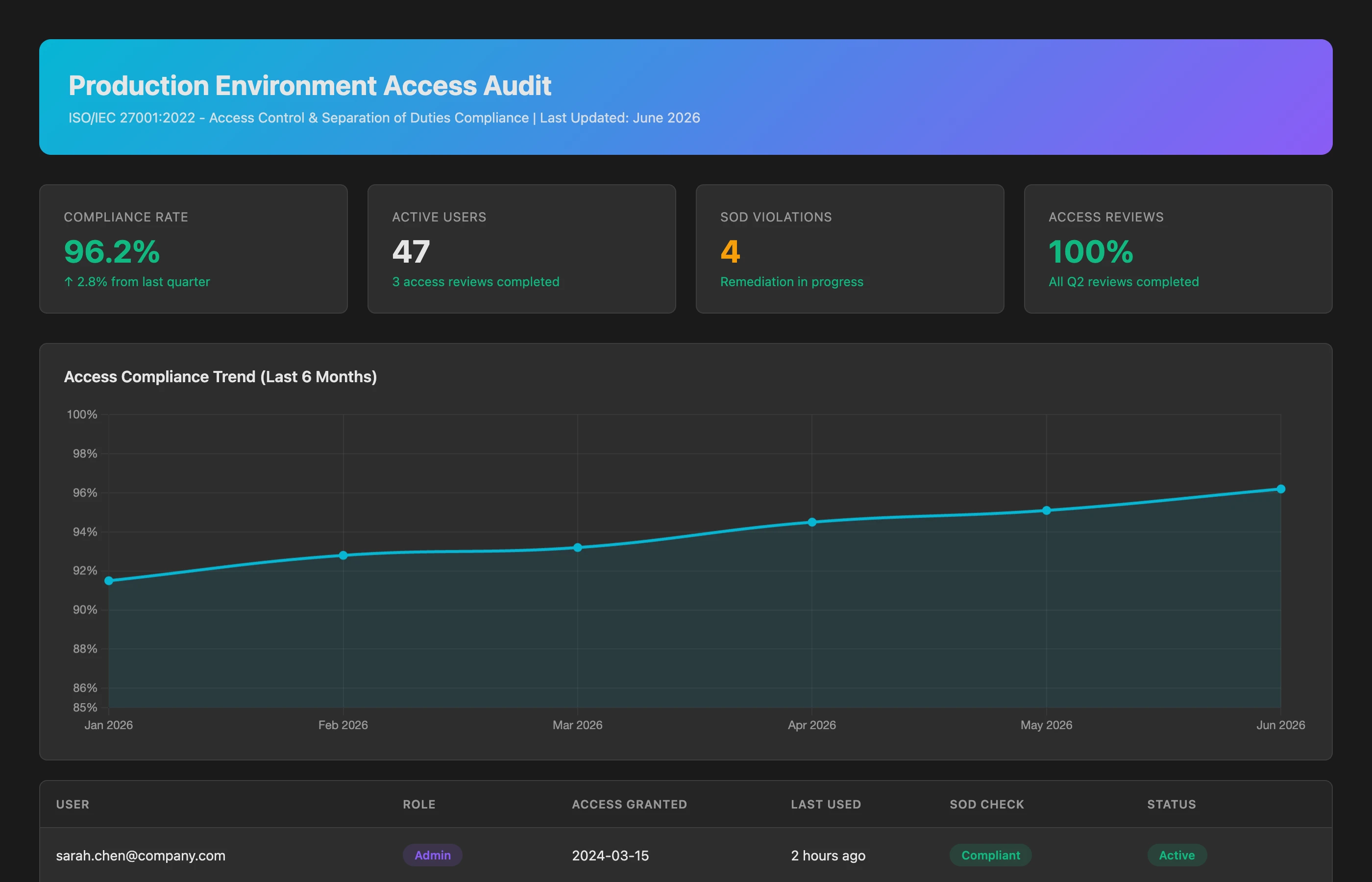
Analyze production environment access for the last 12 months. For each person who had production deployment permissions, show: when access was granted, who approved it, their role at grant time, when access was last used, and when it was revoked (if applicable). Flag any developers who have both merge and deploy permissions. Show the percentage of deployments that went through proper approval workflows vs. direct deployments.
This analysis provides auditors with exactly what they need: proof that production access is controlled, granted through approval workflows, and that separation of duties is enforced.
A.8.32: Change Management - Deployment Traceability
Control requirement: Demonstrate that all production changes are authorized, documented, tested, and traceable.
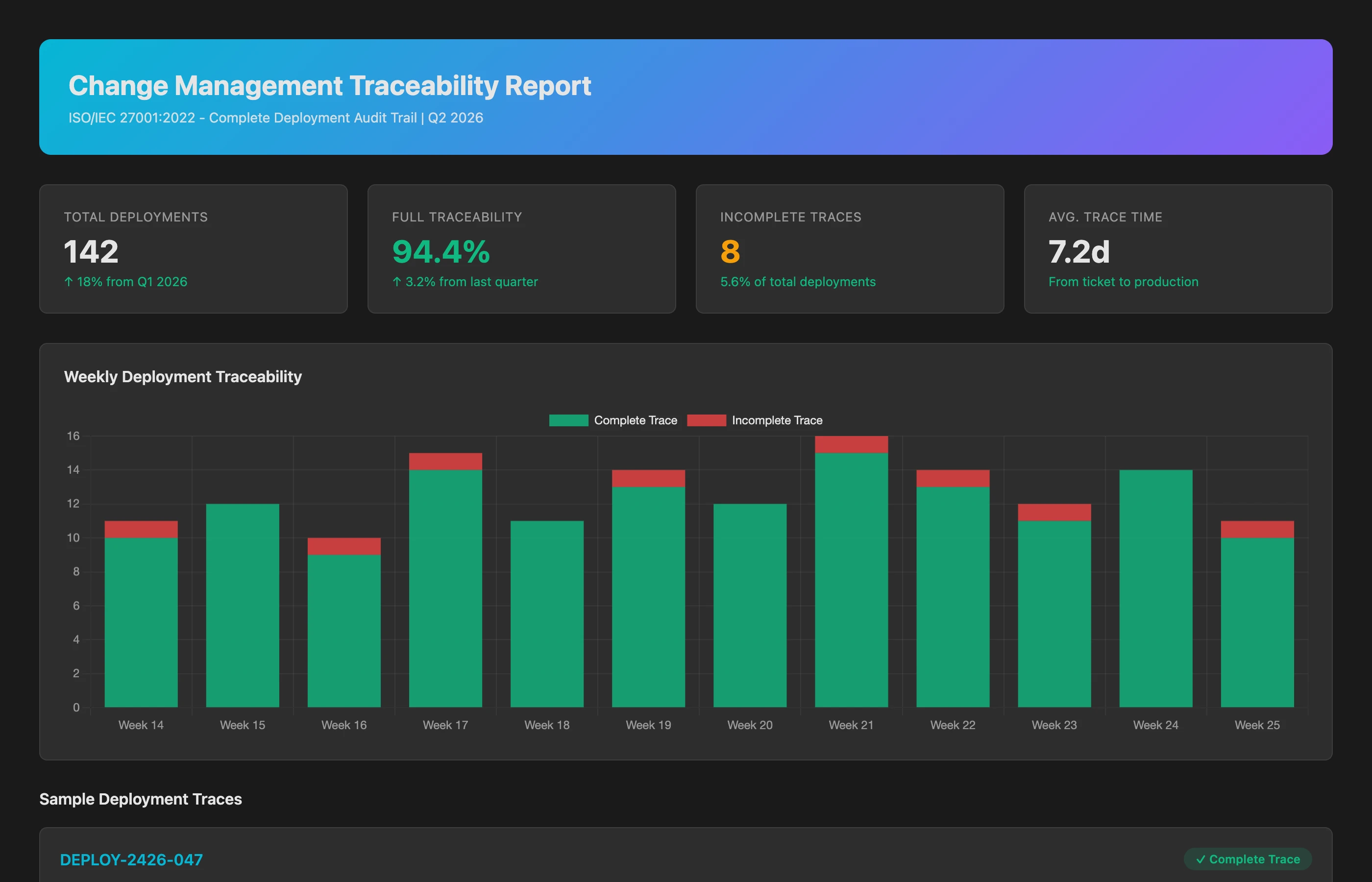
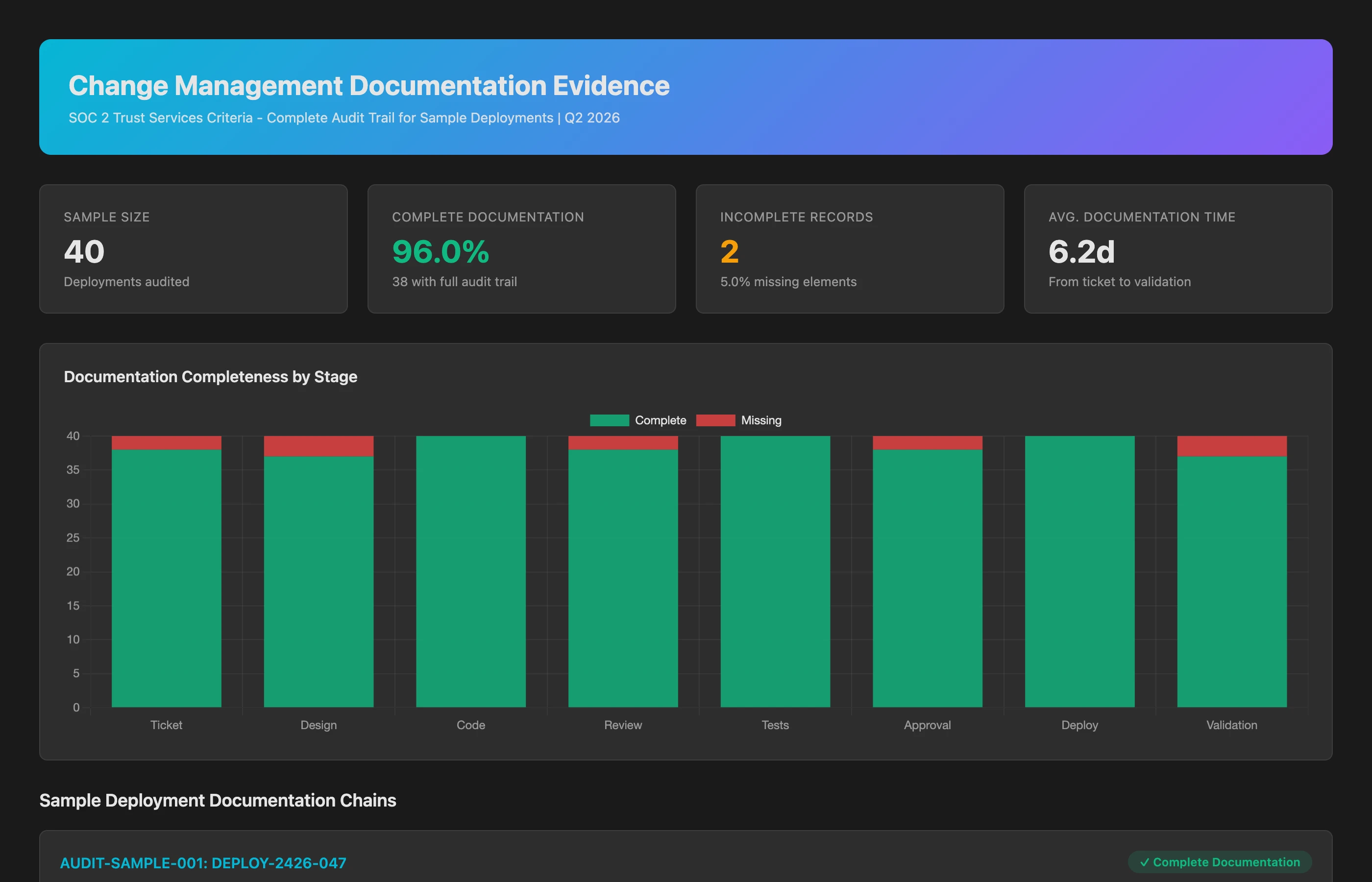
For Q2 2026, analyze all production deployments and show change management traceability. For each deployment, trace back to: the originating Jira ticket (with approval status), associated PRs (with review status), code reviewers (with their authorization level), test execution results, and deployment approval. Flag any deployments that lack complete traceability. Calculate the percentage of fully-compliant deployments.
This single query produces an audit-ready report showing end-to-end traceability that would take days to compile manually.
A.5.15 & A.5.16: Access Control and Identity Management
Control requirement: Show that access is granted on a need-to-know basis, regularly reviewed, and revoked when no longer needed.
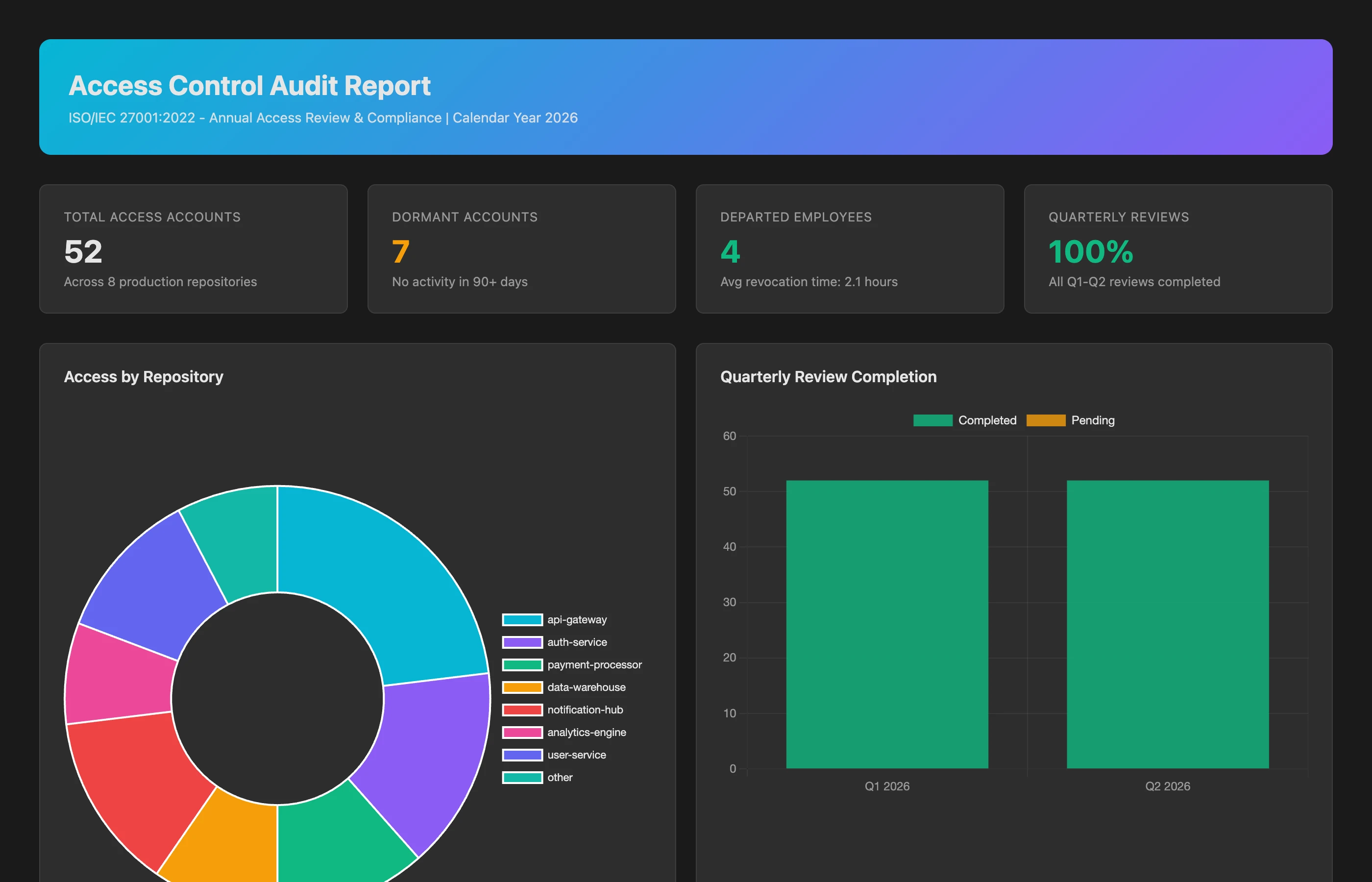
Generate an access control audit report for 2026. For each repository and production system, show: current access roster with roles, access grant dates and approval records, last access date for each user, users who left the company in the last 12 months (and when their access was revoked), and quarterly access review records. Flag any dormant accounts (no activity in 90+ days) or users with excessive permissions compared to their role.
Auditors need quarterly access review evidence. This query generates it instantly, with supporting data showing access is properly managed.
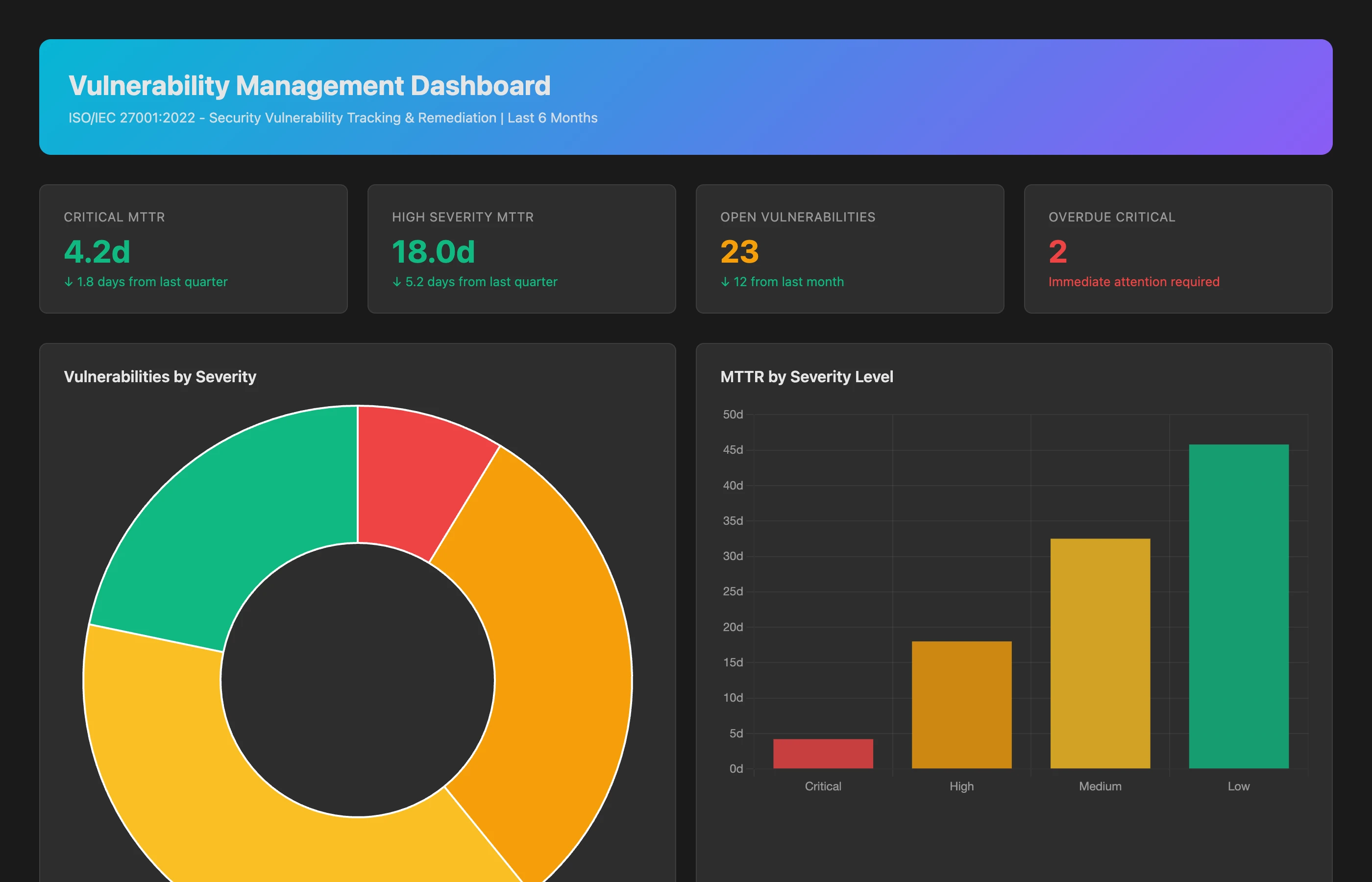
Control requirement: Prove that technical vulnerabilities are identified, tracked, and remediated in a timely manner.
Analyze vulnerability management for the last 12 months. For all security vulnerabilities detected (from Dependabot, Snyk, security scanners), show: vulnerability CVE/ID, severity (critical/high/medium/low), detection date, affected component, remediation status, remediation date (if fixed), and time to remediation. Calculate mean time to remediate (MTTR) by severity level. Flag any critical vulnerabilities open longer than 7 days or high-severity vulnerabilities open longer than 30 days. Show trend over time—is MTTR improving or degrading?
This provides comprehensive evidence that your vulnerability management process is effective, with metrics auditors expect.
Demonstrating SOC2 Trust Services Criteria with Keypup MCP
SOC2 Type II requires proving that controls operated effectively throughout the audit period (typically 12 months). Let's see how Keypup MCP provides this evidence:
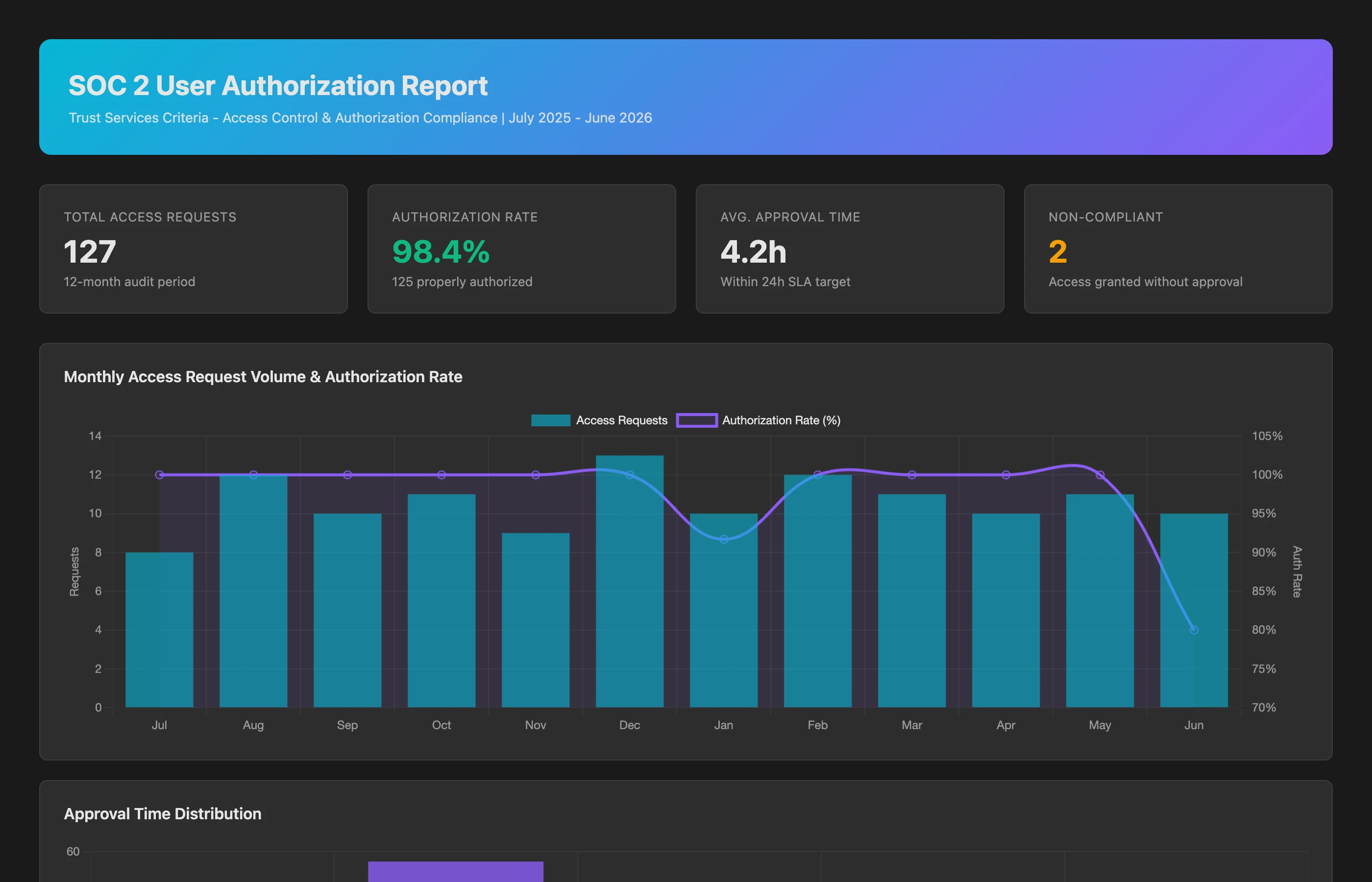
CC6.6: Logical Access - User Authorization
Control requirement: Prove that all system access is authorized before credentials are issued and that authorization follows documented procedures.
For SOC2 audit period (July 2025 - June 2026), generate a user authorization report. For every user who gained access to production repositories or systems, show: user name and role, access request date, requested permissions, approval workflow (who approved and when), access grant date, and whether access aligns with user role. Flag any access grants that lacked proper approval or took longer than 48 hours to process. Show the percentage of access requests that followed proper authorization procedures.
This demonstrates systematic access control procedures operating over the full audit period.
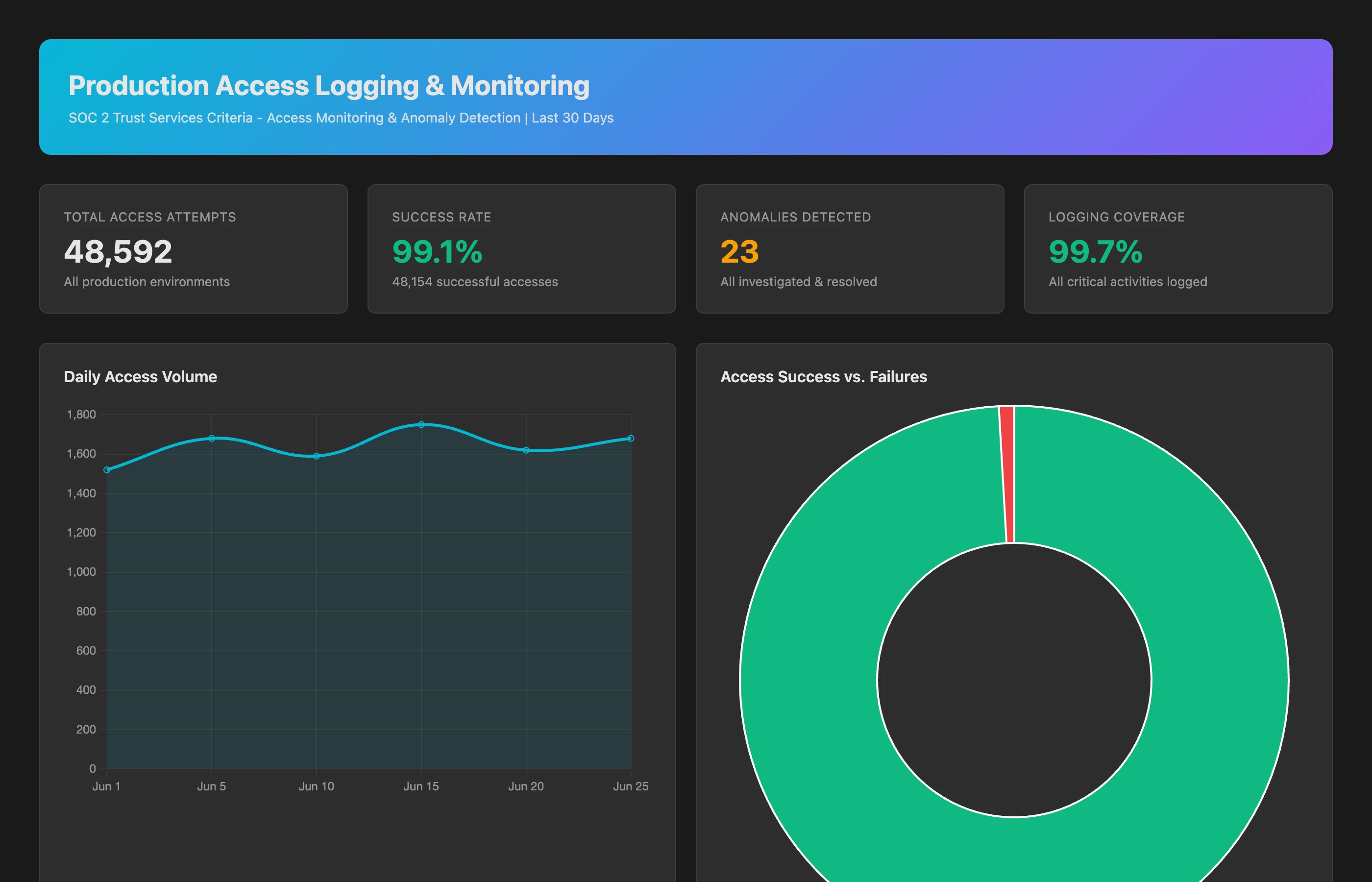
CC6.8: Access Control - Unauthorized Access Prevention
Control requirement: Show that production access is logged, monitored for anomalies, and that unauthorized access is detected and remediated.
Analyze production access logging and anomaly detection for the SOC2 audit period. Show: all production access attempts (successful and failed), users with production access and their usage patterns, any access anomalies detected (off-hours access, unusual activity patterns, access from unexpected locations), and incident response records for any unauthorized access attempts. Calculate the percentage of production activities that are logged and the mean time to detect and respond to access anomalies.
Auditors want proof that access monitoring actually works. This provides operational evidence across the full period.
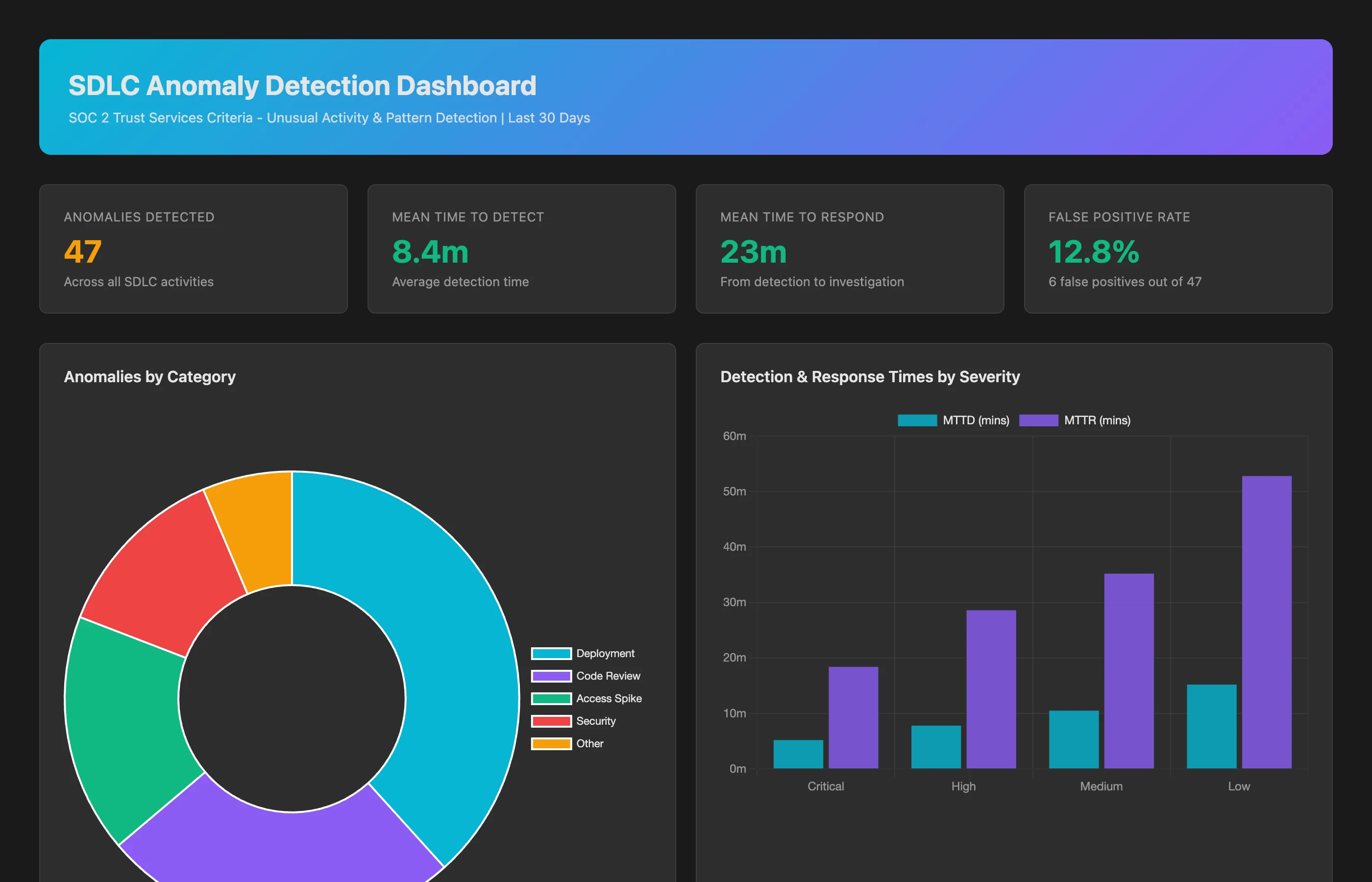
CC7.2: System Monitoring - Anomaly Detection and Response
Control requirement: Demonstrate that system components are monitored for anomalies and that anomalies trigger appropriate response procedures.
Generate a system monitoring report for the SOC2 audit period covering SDLC anomalies. Identify: unusual deployment patterns (deployments outside maintenance windows, rollback frequency spikes, deployment failures), code review bypasses or rubber-stamp patterns, access pattern anomalies (mass permission changes, access spikes), and security incident triggers (vulnerability detection, suspicious commits). For each detected anomaly, show: detection date, anomaly type, severity assessment, investigation records, and resolution. Calculate mean time to detect and respond to anomalies by severity.
This proves your monitoring controls operate continuously, not just when auditors are watching.
CC8.1: Change Management - Complete Documentation
Control requirement: Show that changes are authorized, documented, tested, and approved before deployment.
Provide comprehensive change management evidence for the SOC2 audit period. For a statistically valid sample of production deployments (auditors typically request 25-40 samples), show complete documentation for each: change request (Jira ticket with business justification), design review records, code changes (PR with diffs), code review records (reviewers, comments, approval timestamps), automated testing results, deployment approval chain, deployment execution logs, and post-deployment validation. Calculate the percentage of deployments with complete documentation. Flag any incomplete change records.
Rather than spending weeks assembling this evidence manually, Keypup MCP generates it instantly for any requested sample.
The ROI of Automated SDLC Compliance: Time and Cost Savings
Let's quantify the financial impact of using Keypup MCP Server for ISO27001 and SOC2 Type II compliance.
Initial Certification Time and Cost Reduction
Traditional approach (manual evidence collection):
- Timeline: 8-13 months from kickoff to certification
- Consultant fees: $15K-$40K for gap analysis + implementation support
- Internal time: 600-1000 hours of engineering/security team time
- Audit fees: $20K-$60K depending on company size and complexity
- Total cost: $150K-$400K
Keypup MCP approach (automated evidence):
- Timeline: 4-7 months (40-50% faster due to instant evidence availability)
- Consultant fees: $10K-$25K (less time needed since evidence is already organized)
- Internal time: 200-400 hours (60-70% reduction in evidence collection overhead)
- Audit fees: $15K-$45K (auditors spend less time, lower fees)
- Keypup MCP cost: $12K-$18K for first year (depending on team size)
- Total cost: $60K-$150K
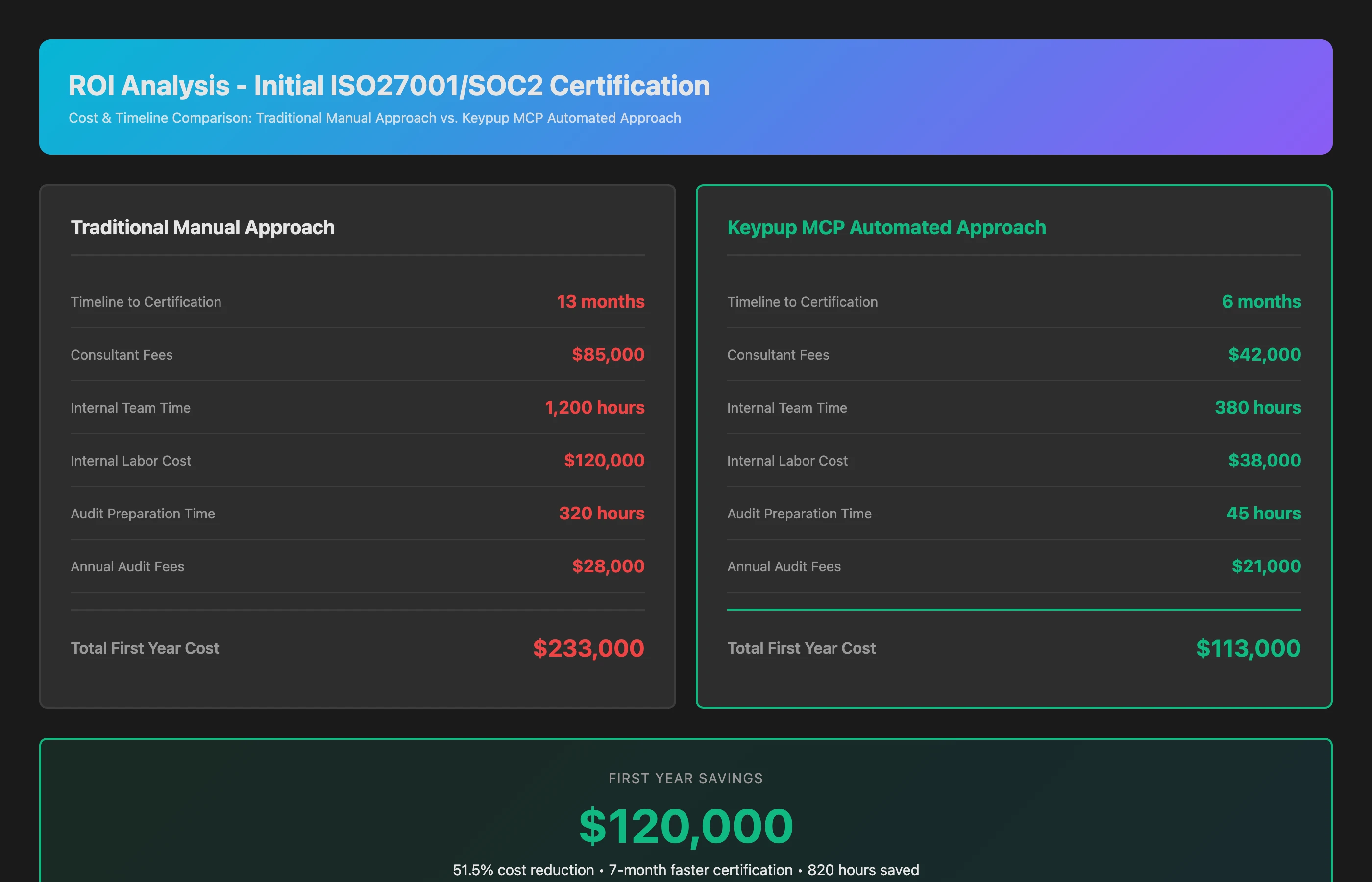
First-year savings: $90K-$250K (average: $120K)
Calculate the ROI of Keypup MCP for initial ISO27001 and SOC2 Type II certification. Compare: total cost with manual evidence collection (consultant fees, internal time at $125/hour loaded rate, audit fees) vs. total cost with Keypup MCP (reduced consultant time, reduced internal time, lower audit fees, plus Keypup subscription). Show the time savings (months faster), cost savings (dollars saved), and ROI percentage. Provide a break-even analysis showing when Keypup MCP pays for itself.
Ongoing Maintenance Cost Reduction
Traditional approach (annual recertification):
- Continuous evidence collection: 200-300 hours annually of engineering time
- Quarterly access reviews: 40-60 hours annually
- Audit preparation: 100-150 hours assembling evidence for annual audit
- Consultant support: $20K-$40K for ongoing compliance management
- Annual audit fees: $15K-$40K
- Total annual cost: $80K-$150K
Keypup MCP approach (always-ready compliance):
- Continuous evidence collection: Fully automated (0 hours)
- Quarterly access reviews: 10-20 hours annually (80% reduction)
- Audit preparation: 20-40 hours (80% reduction, evidence instantly available)
- Consultant support: $5K-$15K (minimal support needed)
- Annual audit fees: $12K-$30K (auditors work faster)
- Keypup MCP cost: $12K-$18K annually
- Total annual cost: $30K-$70K
Annual maintenance savings: $50K-$80K (60-70% reduction)
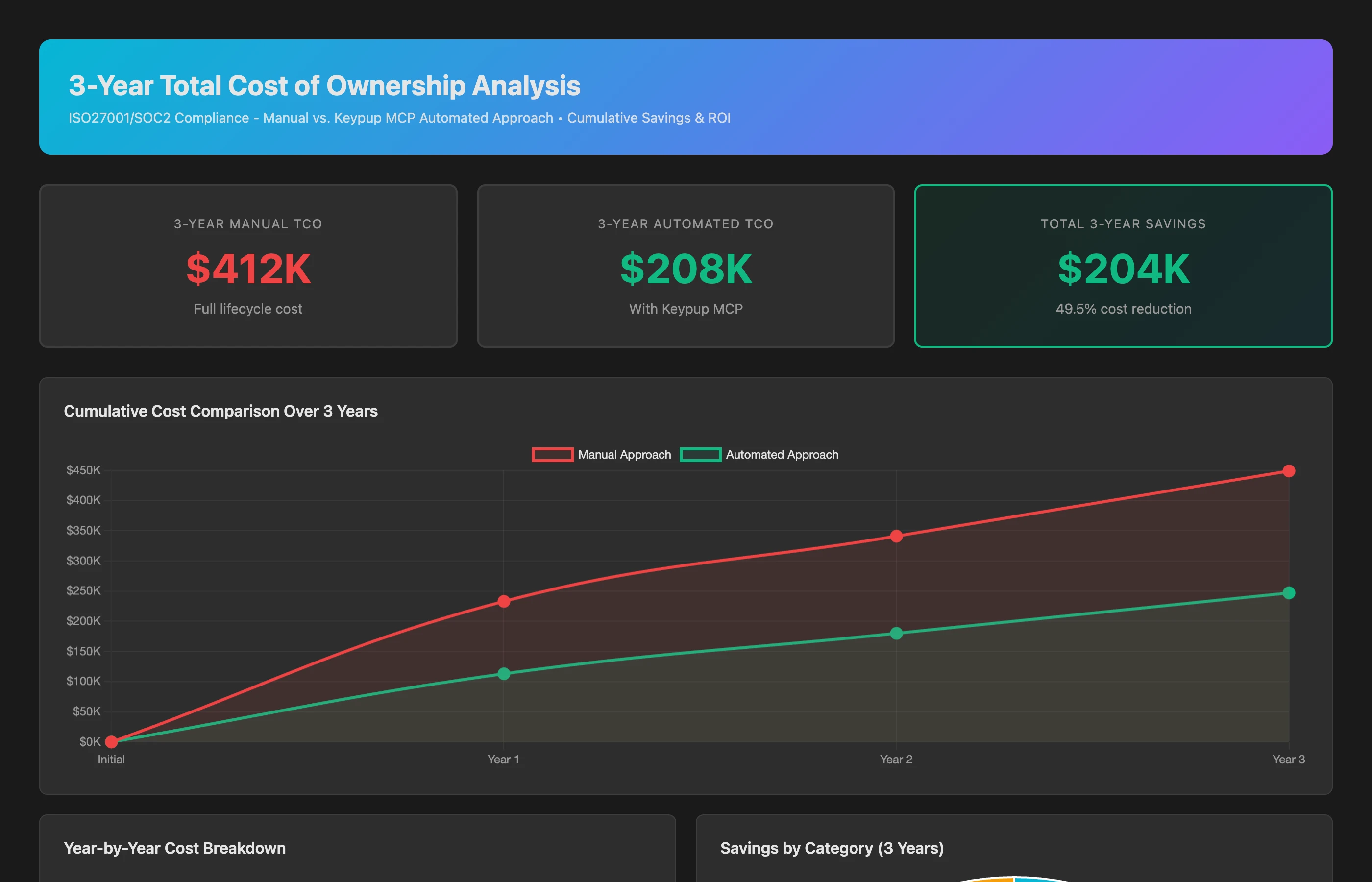
Over 3 years (typical certification cycle), organizations save $150K-$240K in maintenance costs.
Calculate 3-year total cost of ownership (TCO) for maintaining ISO27001 and SOC2 Type II compliance. Compare: traditional manual approach (annual recertification costs, evidence collection overhead, consultant fees) vs. Keypup MCP approach (automated evidence, reduced overhead, lower audit fees). Show year-by-year costs, cumulative savings, and 3-year ROI. Include a sensitivity analysis showing ROI at different team sizes (20 devs, 50 devs, 100 devs).
Beyond Cost: Strategic Benefits
Financial savings are significant, but automated compliance provides additional strategic value:
Always audit-ready: No more scrambling before audits—evidence is continuously available
Real-time compliance visibility: Know your compliance posture at any time, not just during audits
Faster sales cycles: Instantly provide compliance evidence to prospects during due diligence
Reduced compliance risk: Continuous monitoring detects control failures immediately, not months later
Engineering productivity: Developers focus on products, not compliance spreadsheets
Scalability: Compliance overhead doesn't increase linearly as team grows
Best Practices: Implementing Continuous SDLC Compliance
Based on organizations that have successfully achieved and maintained ISO27001/SOC2 with Keypup MCP, here are implementation best practices:
Phase 1: Baseline Assessment (Week 1-2)
Objective: Understand current state and compliance gaps.
Activities:
- Connect Keypup MCP to your SDLC tools (GitHub, Jira, etc.)
- Run baseline compliance analysis across all required controls
- Identify control gaps and non-compliant activities
- Prioritize remediation based on audit risk
Keypup MCP queries to run:
- Current production access roster and approval records
- Last 12 months of deployment traceability
- Vulnerability remediation metrics
- Code review compliance rates
- Access review history
Phase 2: Control Implementation (Week 3-8)
Objective: Implement missing controls and remediate gaps.
Activities:
- Implement technical controls (MFA, role-based access, etc.)
- Document policies and procedures
- Configure Keypup MCP compliance rules and thresholds
- Set up automated alerts for policy violations
- Train team on new processes
Keypup MCP configuration:
- Define compliance rules (e.g., "critical vulnerabilities must be fixed within 7 days")
- Configure real-time alerts for violations
- Set up compliance dashboard for continuous monitoring
Phase 3: Evidence Collection (Week 9-12)
Objective: Build complete audit trail for certification period.
Activities:
- Configure Keypup MCP to generate audit-ready reports
- Customize report templates to match auditor expectations
- Run sample audits to validate evidence completeness
- Create narrative documentation to accompany quantitative evidence
Key reports to generate:
- Quarterly access review reports
- Change management traceability for sample deployments
- Vulnerability remediation records
- Incident response documentation
- Control effectiveness metrics
Phase 4: Pre-Audit Validation (Week 13-14)
Objective: Ensure audit readiness before engaging auditors.
Activities:
- Run mock audit using Keypup MCP evidence
- Identify any evidence gaps or control weaknesses
- Remediate issues before formal audit
- Prepare auditor briefing materials
Objective: Successfully complete certification audit.
Activities:
- Provide auditors with access to Keypup MCP reports (or PDF exports)
- Respond to auditor sample requests instantly using natural language queries
- Provide drill-down detail for any flagged issues
- Complete audit with minimal back-and-forth
Phase 6: Continuous Maintenance (Ongoing)
Objective: Maintain always-ready compliance state.
Activities:
- Monitor compliance dashboard weekly for violations
- Investigate and remediate policy violations immediately
- Run quarterly access reviews using automated reports
- Update compliance rules as controls evolve
- Conduct annual recertification audits in days, not weeks
Common Pitfalls and How to Avoid Them
Organizations implementing SDLC compliance often encounter these challenges:
Pitfall 1: Treating Compliance as a One-Time Project
We spent 9 months getting ISO27001 certified, then immediately stopped paying attention to compliance. A year later, when surveillance audit came around, we discovered our code review compliance had dropped from 98% to 72%. We had to scramble to explain why and implement remediation plans. Continuous monitoring would have caught this degradation immediately.
Solution: Use Keypup MCP dashboards for weekly compliance review. Set alerts for control degradation.
Pitfall 2: Over-Focusing on Documentation, Under-Focusing on Operations
Many teams write beautiful policies but don't implement operational controls to match.
Solution: Use Keypup MCP to validate that documented procedures actually match operational reality. If your policy says "all PRs require 2 reviews," Keypup MCP can prove whether that's true or aspirational.
Pitfall 3: Siloing Compliance Away from Engineering
When compliance becomes "someone else's job," engineers don't understand or follow controls.
Solution: Integrate compliance visibility directly into engineering workflows. Use Keypup MCP dashboards in team meetings to show control effectiveness as an engineering KPI.
Pitfall 4: Manual Evidence Collection Instead of Automation
Some teams use Keypup MCP for monitoring but still manually export data for audits.
Solution: Generate audit evidence directly from Keypup MCP. Train auditors to accept MCP reports as primary evidence source.
Pitfall 5: Ignoring Trend Analysis
Point-in-time compliance snapshots miss degrading controls.
Solution: Track compliance metrics over time using Keypup MCP trend analysis. Identify controls that are weakening before they fail audits.
Conclusion: From Compliance Burden to Competitive Advantage
ISO27001 and SOC2 Type II certifications are increasingly non-negotiable for software companies selling to enterprise customers or raising institutional capital. But achieving and maintaining these certifications doesn't have to be a painful, expensive burden that diverts engineering resources from product development.
By treating SDLC compliance as an operational capability rather than a periodic audit event, and by leveraging automated continuous monitoring through Keypup MCP Server, organizations can:
- Achieve initial certification 40-60% faster (4-7 months vs. 8-13 months)
- Reduce certification costs by $90K-$250K in the first year
- Cut ongoing maintenance costs by 60-70% ($50K-$80K annually)
- Eliminate manual evidence collection overhead (saving 200-400 hours annually)
- Maintain always-ready audit state with real-time compliance visibility
- Scale compliance without scaling overhead as engineering teams grow
Key takeaways:
ISO27001 and SOC2 impose significant SDLC-specific requirements including access control audits, change management traceability, vulnerability remediation tracking, and continuous monitoring—all of which require extensive evidence that lives in your development tools.
Traditional manual approaches are expensive and don't scale, requiring 600-1000 hours of effort and $150K-$400K for initial certification, with ongoing maintenance costs of $80K-$150K annually.
Automated continuous compliance monitoring transforms the economics, reducing overhead by 60-70% while improving compliance posture and audit readiness.
Keypup MCP Server provides SDLC-specific compliance automation with natural language queries that generate audit-ready evidence on demand, eliminating the need for custom scripts, spreadsheets, and manual data compilation.
The ROI is substantial and immediate, with first-year savings of $90K-$250K and 3-year cumulative savings of $200K-$400K, plus strategic benefits like faster sales cycles and reduced compliance risk.
The question for software development organizations isn't "Should we automate SDLC compliance?" but rather "Can we afford not to?" As certification requirements become more stringent and audits more frequent, the gap between automated and manual approaches will only widen.
Organizations using Keypup MCP for continuous SDLC compliance don't just save money—they transform security certification from a painful checkbox exercise into a strategic capability that accelerates sales, enables growth, and demonstrates operational excellence to customers and investors.